In a swimming pool, the safety of the walking surface is a design requirement, not simply a detail. Water, bare feet and continuous foot traffic make the choice of an anti-slip pool grille particularly important, especially in overflow pools. In this article, we look at which aspects to consider, what the main reference standards indicate and how Nexus' TWIN technology addresses the relationship between safety, comfort and design.
Why choose anti-slip pool grilles
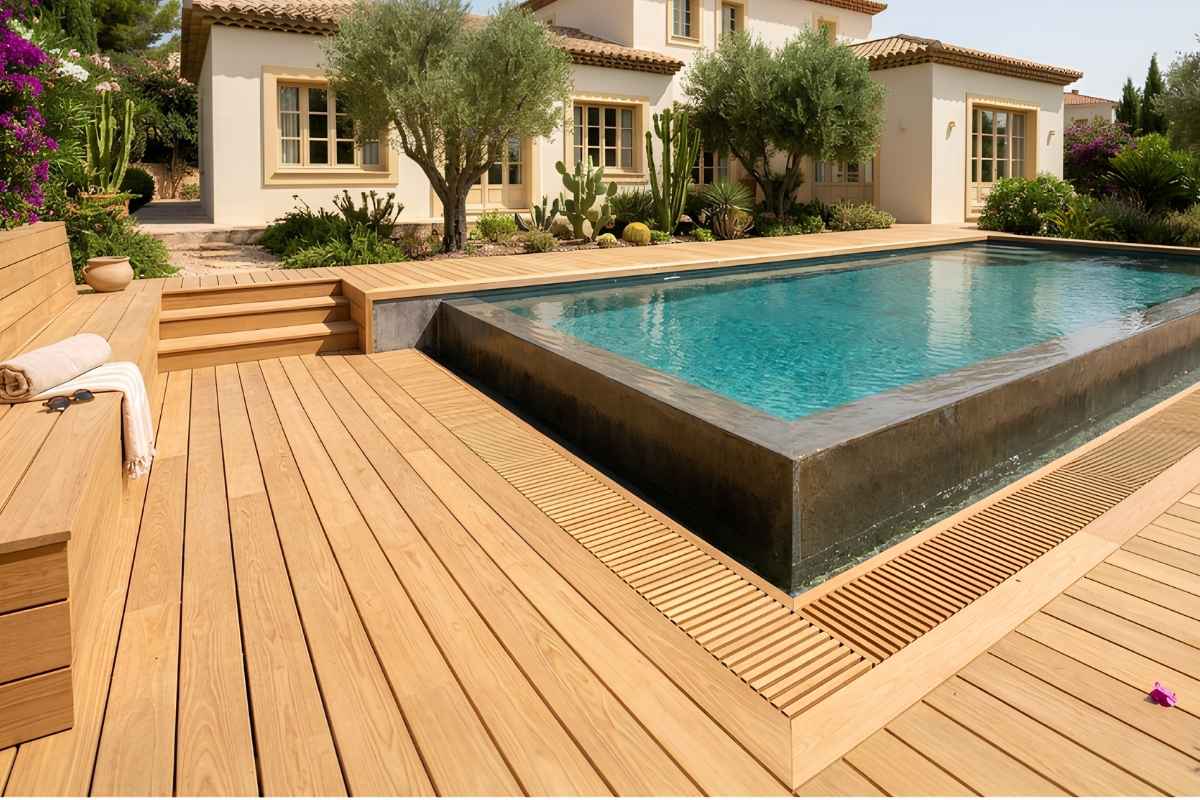
The edge of an overflow pool is an area subject to particularly demanding conditions of use. The constant presence of water on the surface, foot traffic from users walking barefoot and exposure to products used for water treatment make it necessary to pay attention not only to the grille's drainage capacity, but also to how it interacts with those walking on it.
An anti-slip pool grille must therefore provide an adequate level of grip even in wet conditions. It is not enough for the surface to have a particular texture or for the product to be commercially described as "anti-slip": for professional applications, it is important to verify performance through relevant tests and standards.
This issue becomes even more important in public swimming pools, hotels, SPAs, wellness centres and water parks, where the number of users and frequency of use are significantly higher than in a private pool.
In these contexts, the overflow pool grille must be considered an integral part of the pool system's safety features. Its purpose is not only to allow water to flow correctly into the collection channel, but also to help create a walking surface suitable for the typical conditions of a swimming pool environment.
Certified pool grilles: what DIN 51097 and EN 13451-1 mean
When discussing certified pool grilles, it is essential to distinguish between a generic statement regarding anti-slip properties and performance verified through specific testing procedures.
DIN 51097 concerns the determination of the anti-slip properties of floor coverings subjected to wetting and intended for areas walked on with bare feet. The standard provides for a test using an inclined plane and is therefore particularly relevant to environments where the surface is used without footwear.
EN 13451-1, on the other hand, falls within the regulatory framework concerning swimming pool equipment and establishes general safety requirements and test methods for equipment installed in public swimming pools. The DIN documentation currently available refers to EN 13451-1:2020+A1:2024.
For anyone choosing an anti-slip pool grille, understanding these references is important because it makes it possible to assess the product based on objective performance rather than simply on declared characteristics.
Nexus developed TWIN technology with precisely this approach in mind. TWIN grilles have obtained certifications according to DIN 51097 and EN 13451-1, achieving the highest levels in the tests conducted by the company. Certification, of course, does not replace proper system design. Overall safety depends on the integration between the pool edge, overflow channel, drainage system, flooring and the way the pool is used. However, starting with a grille whose anti-slip performance has been properly verified represents an important element in the design process.
TWIN: an anti-slip pool grille combining safety and comfort
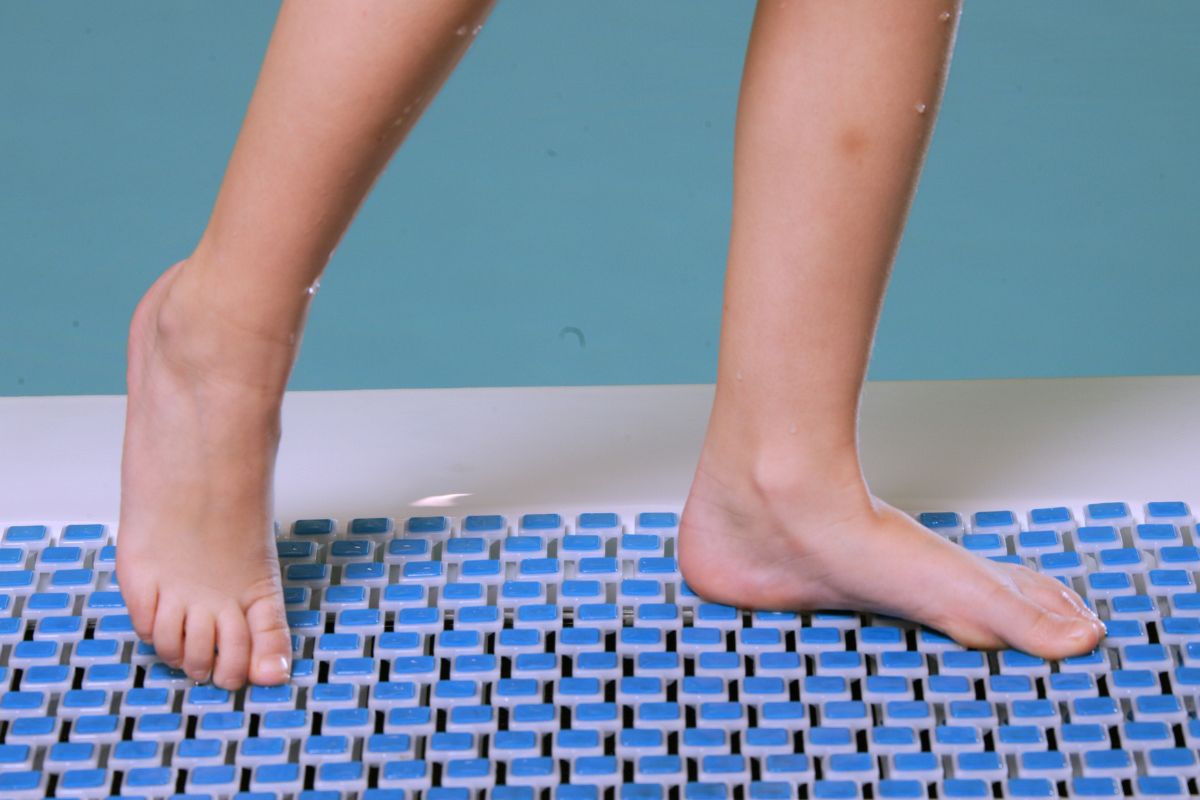
Nexus' TWIN technology was developed to combine anti-slip performance, durability and comfort in a single component. The system uses a polypropylene base into which a contact surface made of thermoplastic elastomer is integrated through an industrial process that creates a bi-material component without the use of adhesives or traditional joints.
This configuration also has an important consequence in terms of user experience. The thermoplastic elastomer surface is designed to be smooth and pleasant to the touch of bare feet, while the absence of protrusions and moving parts helps make walking along the pool edge more comfortable.
The result is an anti-slip pool grille that does not consider safety as an isolated feature, but integrates it with the other requirements that such a component must meet: durability, comfort, longevity and the ability to fit into the architectural design.
It is precisely this last aspect that distinguishes the Nexus range. Safety should not mean giving up aesthetics. The TWIN SCACCO model, for example, is available in flexible, rigid and reinforced versions, with different widths and heights and with the possibility of colour customisation. The bendable versions also make it possible to follow the profile of pools with non-linear geometries.
For projects where the pool edge needs to integrate with porcelain stoneware flooring, Nexus offers TWIN GRES, while for settings where a more natural appearance is desired, TWIN TEAK is available, combining polypropylene and teak. TWIN TEAK has also been developed to combine safety, comfort and adaptability to different pool configurations.
This variety is particularly important in contemporary projects, where the grille is no longer considered simply a technical element to be concealed, but an integral part of the pool's architecture.
From private pools to professional facilities: where certified anti-slip grilles are needed
The choice of certified overflow pool grilles takes on different importance depending on the intended use of the facility. In a private pool, safety and comfort are naturally essential requirements, but the number of users and intensity of use may be limited. In a hospitality or sports facility, on the other hand, the grille may be subjected to a very high number of passages every day.
For this reason, public pool grilles must be assessed particularly carefully, considering not only water drainage but also safety performance, resistance to continuous use and ease of maintenance.
The same applies to hotels, SPAs and wellness centres, where technical requirements must coexist with often very high aesthetic standards. In these contexts, a grille can become part of the interior and exterior design: colours, materials, geometries and dimensions must be able to interact with the flooring and surrounding architecture. Nexus solutions have been developed specifically for use in both residential and professional settings, including SPAs, hotels, water parks and public swimming pools.
Also particularly interesting is their use in high-end projects, such as luxury private pools and yacht installations. In these cases, customisation becomes even more important: a pool edge grille must fit into bespoke spaces, following particular geometries while maintaining both aesthetic continuity and technical performance.
The possibility of working with dimensions, curves, colours and configurations therefore makes it possible to move beyond the concept of a standard product. The choice of grille should start from the actual configuration of the pool, the type of use and the designer's requirements, leading to the most appropriate solution.
Ultimately, an anti-slip pool grille should be assessed as a fully-fledged technical component. Certifications, anti-slip performance, walking comfort, durability, configuration and customisation options all contribute to determining the quality of the final solution.
FAQ – Certified anti-slip pool grilles
- Are anti-slip pool grilles important for safety?
Yes. In overflow pools, the grille surface is frequently wet and is walked on with bare feet. Adequate anti-slip performance therefore contributes to user safety. - What does it mean for a pool grille to be certified?
It means that its performance has been subjected to specific testing procedures according to defined standards. It is therefore important to check which standards were used to assess the product. - What does DIN 51097 verify?
DIN 51097 concerns the determination of the anti-slip properties of floor coverings under wet conditions in areas walked on with bare feet. - What does EN 13451-1 refer to?
EN 13451-1 concerns general safety requirements and test methods for equipment installed in public swimming pools. - Are Nexus TWIN grilles certified as anti-slip?
Yes. Nexus states that TWIN grilles have obtained certifications according to DIN 51097 and EN 13451-1, achieving the highest levels in the tests conducted. - Are anti-slip grilles also suitable for public swimming pools?
Yes, provided that the product is selected according to the characteristics of the installation and the applicable requirements. TWIN solutions are also designed for professional settings such as public swimming pools, SPAs, hotels and water parks. - Can an anti-slip pool grille be customised?
Yes. Some Nexus models can be customised in terms of dimensions, configuration and colours, allowing the grille to be integrated into the architectural design of the pool. - Which grille should be chosen for an overflow pool?
The choice depends on the geometry of the pool, the dimensions of the overflow channel, the intended use and aesthetic requirements. Nexus offers several solutions, including TWIN SCACCO, TWIN TEAK and TWIN GRES, designed for different configurations.
For a residential project, public swimming pool, SPA, hotel or special installation, the choice of an anti-slip pool grille should start from the actual technical requirements of the system. Nexus solutions combine certifications, bi-material technology, walking comfort and customisation options, offering systems designed to integrate into the project without compromising safety.
Contact us to identify the most suitable grille for your pool and receive information about configurations and customisation options.